
Ecommerce Order Fulfillment Process: Steps & Best Practices
Quick answer: The ecommerce order fulfillment process is everything that happens between a customer placing an order and receiving it. It has six main steps: receiving inventory, warehousing, picking, packing, shipping and return processing. To improve it, use software that tracks orders and stock end to end, organize your warehouse around best-sellers, keep enough inventory, use efficient picking methods and work with reliable carriers or a fulfillment partner.
Do you understand the eCommerce order fulfillment process? And why implement order fulfillment? Think of it this way, most customers generally expect their orders to arrive quickly and in high-quality condition. So to guarantee that customers receive their items with few issues, it is best to implement an efficient order fulfillment process. This involves following a clear step-by-step process to ensure that you correctly fulfill your customers’ orders from start to finish.
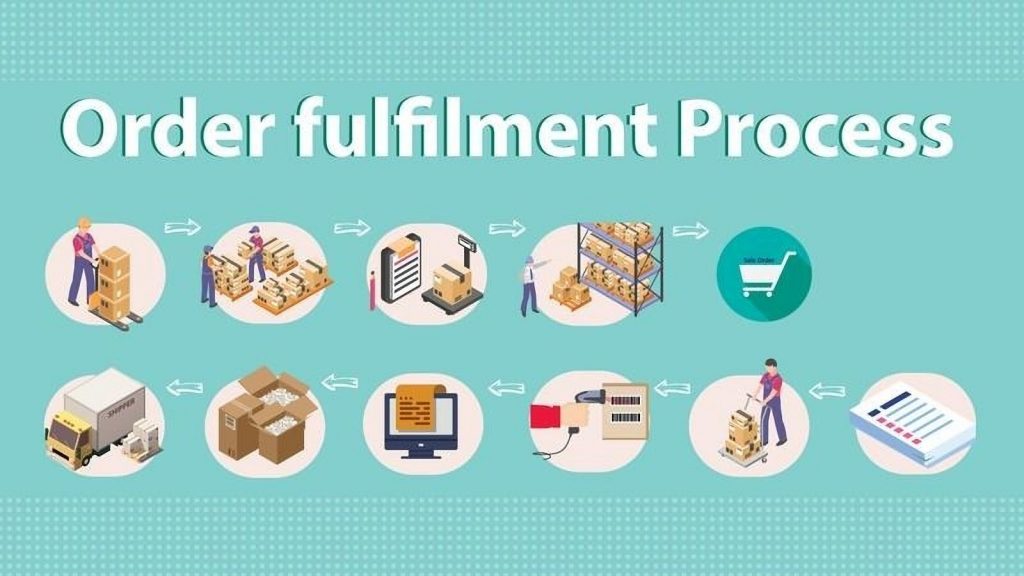
What is Order Fulfillment Process?
In the previous article, we learned what order fulfillment is.
Order fulfillment in the most general sense refers to the series of steps from receiving a customer order to delivering the product. The order fulfillment process is the complete process that involves receiving inventory, warehousing, picking, packaging, shipping items, and even processing returns.
Don’t underestimate its importance. No order fulfilled, no sale. Without sales, there is no business. An efficient order fulfillment process is key to your company’s profitability and ability to retain customers.
What are the Six Steps in the Order Fulfillment Process?
1
Receiving
The first step in order fulfillment is to receive inventory. In any case, after the goods sent by the supplier arrive at the warehouse, the goods to be stored must be checked and inventoried to ensure the proper quantity and quality of the products received.
2
Warehousing
After receiving the inventory, SKUs and barcodes are generated for each product, and the goods are stored in the warehouse in an orderly manner. You can also assign products according to their popularity, and put the best-selling products closest to the packing table, which will improve packing efficiency.
3
Picking
Warehouse packers or automated warehouse robots pick items from the warehouse based on the order content, which contains specific information such as product SKU name, product color, size, unit quantity, and location in the distribution center warehouse.
4
Packaging
The warehouse packers are also responsible for packaging the products, helping you to reduce the cost of shipping per order by reducing the lowest possible actual size weight with the products well packaged. And because of the limited space in the truck, optimizing the dimensional weight of each product can also improve shipping efficiency. If you are using a fulfillment service, you can also specify the requirements on the packing slip.
5
Shipping
Once everything is ready and the package is shipped by the carrier, the seller can send the product’s waybill number to the customer and let them track the product’s shipping status themselves.
6
Return Processing
For online buyers, the ease of returning or exchanging a product also largely influences whether a customer wants to buy that product or not. To ensure that returns are received, exchanged, and refunded as efficiently as possible, you need to design a clear return policy that is easy to use for both your buyers and your staff. Return processing includes quality checks and sorting of returned products, re-stocking of returned products, and automation can help you avoid unnecessary confusion and errors.
Benefits of Having an Order Fulfillment Process
Start with the basics
Simplify your receiving process so that incoming goods are processed quickly and damaged goods are returned to the manufacturer for replacement.
Improve picking time
Put hot ticket items in front and close to manual or robotic pickers and Packers.
Organize transportation and logistics
Plan a transportation backup strategy in case something goes wrong or the carrier accidentally raises rates beyond your profit level.
Automation
Automating as much as possible can save labor costs, improve working conditions, and make operations safer.
7 Steps to Improve Your E-commerce Order Fulfillment Process
Choose a system that provides end-to-end tracking of orders, inventory, and all other aspects of your business.
Modern ERP systems enable you to integrate directly with suppliers and vendors. Set up your rules and decide with your suppliers and vendors which tasks can be automated.
Most companies wisely heed the business adage: under-promise, over-deliver.
If your inventory is too low, you may face the risk of out-of-stock and shortage of customer orders. Working capital and storage costs can get out of control when you hold too much inventory.
The effective use of your human capital is essential to reduce costs and improve the efficiency of order fulfillment operations. Common order-picking strategies include discrete order picking, regional and bulk order picking, and other strategies designed to limit travel time and improve picking speed.
Organizations such as the United States Postal Service, UPS, FedEx, and DHL play a key role in your performance.
While you try to provide every customer with the perfect experience, mistakes, defects, and delays occur.
Conclusion
An efficient order fulfillment process directly impacts customer satisfaction and sales. Whether the exciting start-up phase or decades of order fulfillment experience, never too late to take a fresh look at your order fulfillment and management system. Following the seven-step process above can identify opportunities to reduce costs while providing a better customer experience. This is a win-win for any business and its valued customers.
Do you want to know how to improve the order fulfillment process in your business? Honest Fulphilment can help you reduce order fulfillment cycle time and we can help unlock the potential of your business.
With our help, you can spend your valuable time developing better sales and marketing strategies for your business, while we complete all the critical steps of the order fulfillment process for your business.
Want to learn about Honest Fulphilment and how it can help you improve your eCommerce order fulfillment process? Get in touch with us today!


FAQ
What are the steps of the ecommerce order fulfillment process?
The main steps are receiving inventory, warehousing (storing stock by SKU), picking the ordered items, packing them, shipping the parcel with tracking, and processing returns.
How can I improve my ecommerce fulfillment process?
Use software that tracks orders and inventory end to end, keep best-sellers close to the packing area, set reorder points to avoid stockouts, use efficient picking methods such as batch picking, and have backup carriers. Outsourcing to a 3PL is another option.
What are ecommerce fulfillment best practices?
Inspect stock on arrival, organize storage by SKU and sales velocity, automate order import, optimize packaging to cut dimensional weight, share tracking numbers quickly and keep a simple, clear return policy.
What are the order fulfillment models?
There are three main models: in-house fulfillment, where you pack and ship orders yourself; third-party fulfillment, where a 3PL does it for you; and dropshipping, where the supplier ships directly to the customer.
What does order completed mean?
An order is completed when the customer has received it. Before that it moves through statuses such as pending, fulfilled or shipped, and in transit.