
What Is Supply Chain Integration? Types and Benefits
Quick answer: Supply chain integration means linking every part of the supply chain — suppliers, factories, warehouses, carriers and sellers — so they share data, plans and goals and operate as one coordinated system. It can be vertical (controlling or partnering along the chain) or horizontal (joining forces with companies at the same stage), and internal or external. The result is lower costs, faster delivery and fewer stock problems.
To recover from large-scale global supply chain disruption, it is very important to choose a supply chain strategy.
What is Supply Chain Integration?
Supply chain integration covers all activities in the supply chain, from raw materials to consumers: the flow of goods, the generation, storage and flow of related information, and the planning, organizing and controlling of those activities. There are two main directions:
Horizontal Integration
Horizontal integration means joining or partnering with companies at the same stage of the supply chain — for example, two distributors merging or agreeing to cover different markets — to gain scale and reach more customers.
Vertical Integration
Vertical integration refers to the effective integration of suppliers, factories, warehouses, and shops along the chain. The manufacturing and distribution of products are carried out in the correct quantity, time, and place to meet the needs of customers and minimize the system cost.
What are the Benefits of Supply Chain Integration?
Improve the core business
Enhancing the ability to resist risks
Efficient information interaction
Reducing operating costs
Improving customer satisfaction
Successfully replicating the system
How to Integrate Your Supply Chain?
Do you need to reduce procurement costs, align business objectives with partners, acquire businesses to improve market dominance, and speed up delivery time and reliability? The defined integration goal should guide the whole supply chain integration process.
How does information flow between businesses and different links in the supply chain? How and how fast does the cash flow between partners flow? Identify bottlenecks, communication barriers, slow suppliers, overpriced suppliers, and problems that interfere with business efficiency and profitability.
Determine whether the supply chain integration goal is best achieved through horizontal integration, vertical integration, or both:
Horizontal integration: Horizontal integration involves a company buying a company to eliminate competition and immediately expand its customer base, or a partnership in which each company agrees to focus on a specific market segment or geographical area.
Vertical integration: Vertical integration involves the business purchase or partnership with widget manufacturers to improve integration and efficiency and ensure fair widget prices and timely delivery.
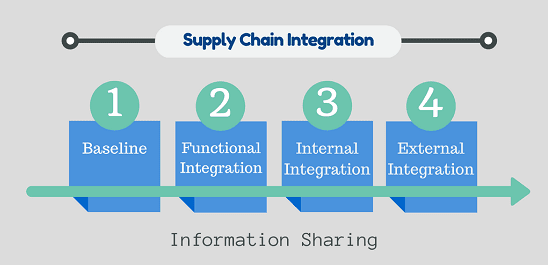
The following four levels of integration are provided:
Baseline: Maintain isolated information within each department or “supply chain link”.
Integration: All information is shared equally throughout the supply chain. The goal of information sharing is to improve the efficiency of the supply chain.
Internal integration: Information is shared among all departments within the company, such as purchasing, warehousing, sales and finance, so they plan together instead of operating as separate units.
External integration: An alliance with the suppliers, logistics providers and customers that make up the supply chain.
Working with a full-service integrated logistics provider helps e-commerce businesses of all sizes serve customers effectively and expand when needed, without a large investment. For online sellers, a sourcing and fulfillment partner that connects to your store can combine purchasing, quality inspection, storage and shipping in one integrated flow.
Conclusion
With the passage of time, the influence of choosing an appropriate supply chain strategy is constantly evolving. The push-pull strategy in supply chain operation has unique advantages and functions for the supply chain operation of enterprises. The possibility of using a hybrid model is also important.
After large-scale global supply chain disruptions, it is very important to choose a supply chain strategy. Choose a specific supply chain strategy to meet the needs of customers and push the business forward! If you want to know more, you can contact us!


FAQ
What is supply chain integration?
Supply chain integration is the close coordination of every link in a supply chain — suppliers, manufacturers, warehouses, carriers and sellers — so they share information, plans and goals and work like one system instead of separate companies.
What are the types of supply chain integration?
The main types are vertical integration (owning or tightly partnering with stages up or down the chain, such as a brand running its own factory or warehouse) and horizontal integration (joining or partnering with companies at the same stage). Integration can also be internal (between departments) or external (with suppliers and customers).
What is supplier integration?
Supplier integration means connecting your suppliers directly to your planning and ordering processes, for example by sharing forecasts and inventory levels or linking systems, so they can deliver the right goods at the right time.
What is an example of supply chain integration?
An online store that connects its Shopify shop to a sourcing and fulfillment agent is a simple example: orders flow automatically to the agent, who buys from the factory, inspects, stores, packs and ships the goods, and sends tracking numbers back to the store.
What are the benefits of supply chain integration?
Integration lowers operating and inventory costs, speeds up delivery, improves information flow and forecasting, reduces risk from supplier problems and raises customer satisfaction.