
What Is 2PL Logistics? Second-Party Logistics Explained
Quick answer: 2PL (second-party logistics) is a carrier that owns the transport assets — trucks, ships, planes or trains — and moves your goods from one point to another, for example an ocean shipping line or a trucking company. The shipper (first party) still plans the logistics and handles storage; the 2PL only does the transport. A 3PL goes further and also manages warehousing, inventory and order fulfillment.
1PL to 5PL at a glance
| Model | What it covers | Example |
|---|---|---|
| 1PL | The brand ships its own orders | A small store posting parcels |
| 2PL | Transport only | Air freight or a courier contract |
| 3PL | Storage, pick, pack and ship | Our China warehouse |
| 4PL | Manages several logistics providers | A supply chain integrator |
| 5PL | 4PL plus e-commerce network design | Marketplace-wide logistics planning |
| According to the actual logistics undertaker, we refer to different logistics forms as different logistics parties. In this article, we will discuss what 2PL logistics is, and you can learn more about the advantages and disadvantages of 2PL. I also recommend options for simplifying the 2PL process for you. |
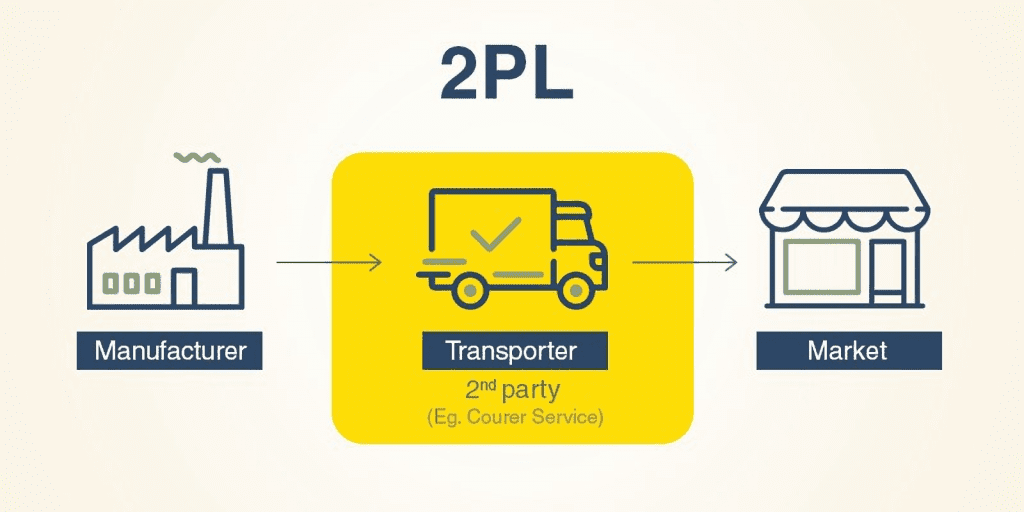
What is 2PL Logistics?
2PL (Second party logistics) Logistics refers to the logistics organized by buyers, sellers, or distribution companies. The core business of these logistics organizations is to purchase and sell goods, so 2PL is also called buyer logistics. Whether it is a traditional distribution enterprise or a modern e-commerce retail enterprise, it also has a certain scale of logistics implementation of warehousing, transportation, or distribution to undertake the logistics and transportation tasks of the enterprise.
Let’s take a t-shirt business as an example. Suppose one of your clients is Old Navy, a classic American clothing store. You need to ship the t-shirts in bulk to the Old Navy warehouse, so you contact the 2PL supplier and arrange for the supplier to ship the t-shirts. From there, Old Navy pays for the rest of the distribution, as agreed in your contract.
What does a 2PL Provider do?
1
Loading and Unloading Items
2PL Provider needs to pick up the goods at the warehouse and load them onto the truck. And provider needs to ensure that all items are loaded safely and accurately.
2
Transporting goods
Be aware of the mode of transport, the cargo on board, and the destination of the goods.
What are the Examples of 2PL Logistics?
Any freight forwarding company includes shipping lines that operate the ships, airlines that operate the planes, and hauling companies that operate vehicles.
The more typical ones are JD.com, Amazon, Cainiao, and Suning. Representative companies in second-party logistics, such as Jingdong Logistics. After JD.com places an order from a production enterprise, JD.com organizes its own vehicle source to pick up the goods, and then deliver them to the No. 1 warehouse in Asia.
Then there’s the Woodbridge, NJ-based trucking company, a logistics service provider to and from all over the world.
Honest FulPhilment offers 2PL logistics services with a wide range of contacts and freight forwarding partners that can send your goods by any means. Honest FulPhilment will choose the most competitive price for you and can even handle all the customs clearance and documentation processes, taking all the hassle and complexity out of it for you. Feel free to contact us if you need anything.
What are the Pros and Cons of 2PL?
Is 2PL right for all organizations? It depends on the needs of different companies. That is, there are advantages and disadvantages of second-party logistics.
The Pros of 2PL
Provide enterprises with strong competitiveness. Enterprises regard logistics service as an important capacity building, which can provide strong competitiveness for their own business.
2PL logistics can save a lot of money.
Provide diversified choices for enterprises. 2PL logistics will provide different modes of transportation, which is flexible and convenient in outsourcing supply chain. Enterprises will also have more choices.
Enterprises using 2PL providers can reduce complexity. It is very complicated for enterprises to arrange their own trucks. 2PL suppliers can solve this problem.
The Cons of 2PL
It is difficult for commercial enterprises themselves to build an effective logistics network.
There is a risk of cargo transport delay. This happens because some companies do not comply with the contract. However, a backup system can be established to solve this problem.
The scope of application is small. 2PL logistics is applicable to the external management of a part of the supply chain.
2PL vs 1PL vs 3PL
| Type | Who it is | What it does |
|---|---|---|
| 1PL | The shipper itself (manufacturer, seller) | Moves its own goods with its own resources |
| 2PL | Carrier (shipping line, airline, trucking company) | Transports goods with its own vehicles or vessels |
| 3PL | Third-party logistics provider | Manages warehousing, inventory, pick and pack and shipping through several carriers |
How to Simplify the 2PL Process?
Freight and logistics are extremely complex areas of your e-commerce operations and can often require you to spend a lot of time bouncing metrics and data between suppliers and shipping agents to get quotes, so in order to save time and simplify the process, you need to find a professional personnel responsible.
Turn to Honest FulPhilment and we can help you simplify the process. We will give you a quote and give you different options, all you need to do is tell us your needs and supplier contact details.We will explain them in an easy-to-understand manner so that you can make an informed and well-thought-out decision.
Conclusion
In short, second-party logistics is the enterprise’s own logistics system, which is a logistics mode between a completely independent logistics mode and a complete outsourcing mode of the enterprise. While enterprises have greater autonomy, they are not completely independent. Establishing an efficient logistics system is the source of profit for an enterprise, so it is very important to seek professional logistics.
If you want to know more about 2PL logistics, I hope you will contact us – Honest FulPhilment. We will offer you a full range of services.


Related reading: What is the difference between 3PL 4PL and 5PL
FAQ
What is 2PL logistics?
2PL (second-party logistics) is a logistics provider that owns and operates the transport assets, such as trucks, ships or planes, and moves goods for a shipper from one point to another. The shipper still plans the logistics; the 2PL only carries out the transport.
What does 2PL stand for?
2PL stands for second-party logistics. The first party is the shipper (the company that owns the goods), and the second party is the carrier that physically transports them.
What are examples of 2PL companies?
Shipping lines that operate vessels, airlines that operate cargo planes, trucking companies and rail operators are all 2PL providers. Retailers with their own delivery fleets, such as JD Logistics, also work as second-party logistics.
What is the difference between 2PL and 3PL?
A 2PL only transports goods using its own vehicles or vessels. A 3PL manages a wider part of the supply chain, such as warehousing, inventory, pick and pack and shipping through several carriers, often without owning the transport assets.
Is 2PL the same as a freight forwarder?
Not exactly. A 2PL owns the transport assets, while a freight forwarder arranges shipments on other companies' ships, planes and trucks. Many shippers use a forwarder or agent to book and compare 2PL carriers for them.