
Shopify Third-Party Fulfillment: How a 3PL Works
Quick answer: Third-party fulfillment on Shopify means a 3PL (third-party logistics) company connects to your store through a Shopify app and ships your orders for you. The app adds the 3PL as a fulfillment service location; orders for products assigned to it are sent to the 3PL automatically, the warehouse picks, packs and ships them, and the tracking number syncs back so Shopify marks the order fulfilled and notifies your customer.
Below: what happens inside Shopify, how to set it up, what it costs, how to choose a Shopify 3PL, and how it works with our Shopify fulfillment app.
What is third-party fulfillment?
Fulfillment is everything between “order placed” and “parcel handed to the carrier”: storing stock, picking, packing, labelling and shipping. A Shopify store can handle it in three ways:
| Model | Who holds the stock | Who packs and ships | Best for |
|---|---|---|---|
| Self-fulfillment | You | You | Very low volume, full control |
| Third-party fulfillment (3PL) | The 3PL’s warehouse | The 3PL | Growing stores that want to stop packing |
| Dropshipping | The supplier | The supplier | Testing products with no inventory |
The lines blur in practice. Some 3PLs, including ours, also source products and ship them order by order, so you can start without stock and move inventory into the warehouse once a product sells.
How third-party fulfillment works inside Shopify
Shopify treats a 3PL as a fulfillment service: a special location in your store, next to your own warehouse or home address. Once the 3PL’s app is installed:
- A 3PL location is added. In Shopify admin you will see it under Settings → Locations (or as a fulfillment service), created by the app.
- Products are assigned to it. You choose which products or variants the 3PL stocks and ships. Anything not assigned keeps shipping from your other locations.
- Orders become fulfillment requests. When a customer pays, Shopify splits the order by location and sends the 3PL a fulfillment order for its items.
- The 3PL accepts and ships. Its warehouse picks, packs and labels the parcel and hands it to a carrier.
- Tracking flows back. The 3PL creates the fulfillment with the tracking number. Shopify marks the items Fulfilled and sends your customer the shipping confirmation email.
- Stock levels sync. The 3PL updates inventory at its location, so your storefront does not oversell.
If an order sits in Unfulfilled for too long, the cause is usually one of these steps: the product is not assigned to the 3PL location, the fulfillment request was not accepted, or the order is on hold. See why Shopify orders stay unfulfilled for the fixes.
How to set up a 3PL for your Shopify store
- Shortlist 3PLs with a native Shopify app. CSV uploads and email order lists break as soon as volume grows.
- Install the app and authorize it. This creates the fulfillment service location and lets the 3PL read orders and write tracking.
- Get products into the warehouse. Ship your inventory in, or ask the 3PL to source it for you.
- Map SKUs and shipping methods. Match each Shopify variant to the 3PL’s SKU, and each shipping rate you show at checkout to one of the 3PL’s shipping lines.
- Fund the account or agree billing. Many 3PLs, especially overseas ones, work on a prepaid wallet.
- Place a test order. Check that it reaches the 3PL, ships, and comes back to Shopify with tracking before you send real traffic.
What does Shopify third-party fulfillment cost?
3PL quotes are hard to compare because every provider bundles fees differently. The common lines are:
- Receiving: per pallet, carton or hour when your stock arrives
- Storage: per cubic foot, pallet or bin per month (some include a free period)
- Pick and pack: per order, plus per extra SKU or unit
- Packaging: standard mailers or boxes, and any custom branded packaging
- Shipping: the carrier rate, sometimes with a margin added
- Extras: kitting, inserts, returns, account minimums or setup fees
Work out the total cost per order for your typical basket instead of comparing pick and pack rates alone. Our 3PL pricing models guide explains the main structures, and our own rates are public on the pricing page.
When should a Shopify store use a 3PL?
- Packing takes hours that should go into marketing and product
- You are out of space at home or in your stockroom
- Wrong items, missed orders or late dispatch are starting to cost reviews
- You sell internationally and need more or cheaper shipping options
- You want branded packaging, inserts or bundles without doing them by hand
The advantages of Shopify 3PL fulfillment covers the trade-offs in more detail.
How to choose a Shopify 3PL
Use these questions when you compare providers. Our longer guide on how to choose a 3PL provider goes deeper.
| Question | Why it matters |
|---|---|
| Is there a native Shopify app that syncs orders, stock and tracking? | Manual order handling causes delays and errors |
| When is tracking pushed to Shopify? | Tracking pushed before the parcel really ships makes delivery data and customer emails wrong |
| Where are the warehouses, and which shipping lines can I use? | Decides delivery times and cost for your main markets |
| Can I route only some products to the 3PL? | Lets you test with a few SKUs first |
| Do you offer branded packaging, inserts and bundles? | Turns a generic parcel into a brand experience |
| Are there minimums, contracts or setup fees? | Small stores should avoid lock-in |
| How are returns and lost parcels handled? | The expensive part is the edge cases |
| Can I connect more than one store? | Matters once you run several Shopify or WooCommerce stores |
Domestic 3PL or a China-based fulfillment partner?
A domestic 3PL in your customers’ country gives the fastest delivery, but you must buy stock in bulk, import it and pay local storage and labour rates. A China-based fulfillment partner sits next to the factories: it can source products, check quality and ship order by order, with lower product and labour costs, while transit to customers is longer. Many brands combine the two, testing products from China and moving best sellers into a local warehouse.
How it works with Honest FulPhilment
Honest FulPhilment is a China-based sourcing and fulfillment partner founded in 2019, with its own warehouse and a free Shopify app launched in August 2020. With our Shopify fulfillment app:
- Install the free app from the Shopify App Store and authorize it. Your account is created on the spot and Honest FulPhilment is added to your store as a fulfillment service. Step-by-step screenshots are in how to connect your Shopify store.
- Add products. Send a sourcing request with a product link or photo and we quote product and shipping cost (average sourcing time is 4–5 days), or send your own stock to our warehouse, with free storage for the first 2 months.
- Map SKUs and shipping, and add custom packaging, inserts or bundles per SKU. Push real weight-based checkout prices with Shopify Rate Sync.
- Top up your wallet. Paid orders sync automatically; we pick, inspect (20% of products by default at no extra cost), pack and ship them on 30+ shipping lines. Stocked orders are dispatched within 24 hours.
- Tracking syncs to Shopify the moment the parcel is physically dispatched, never before.
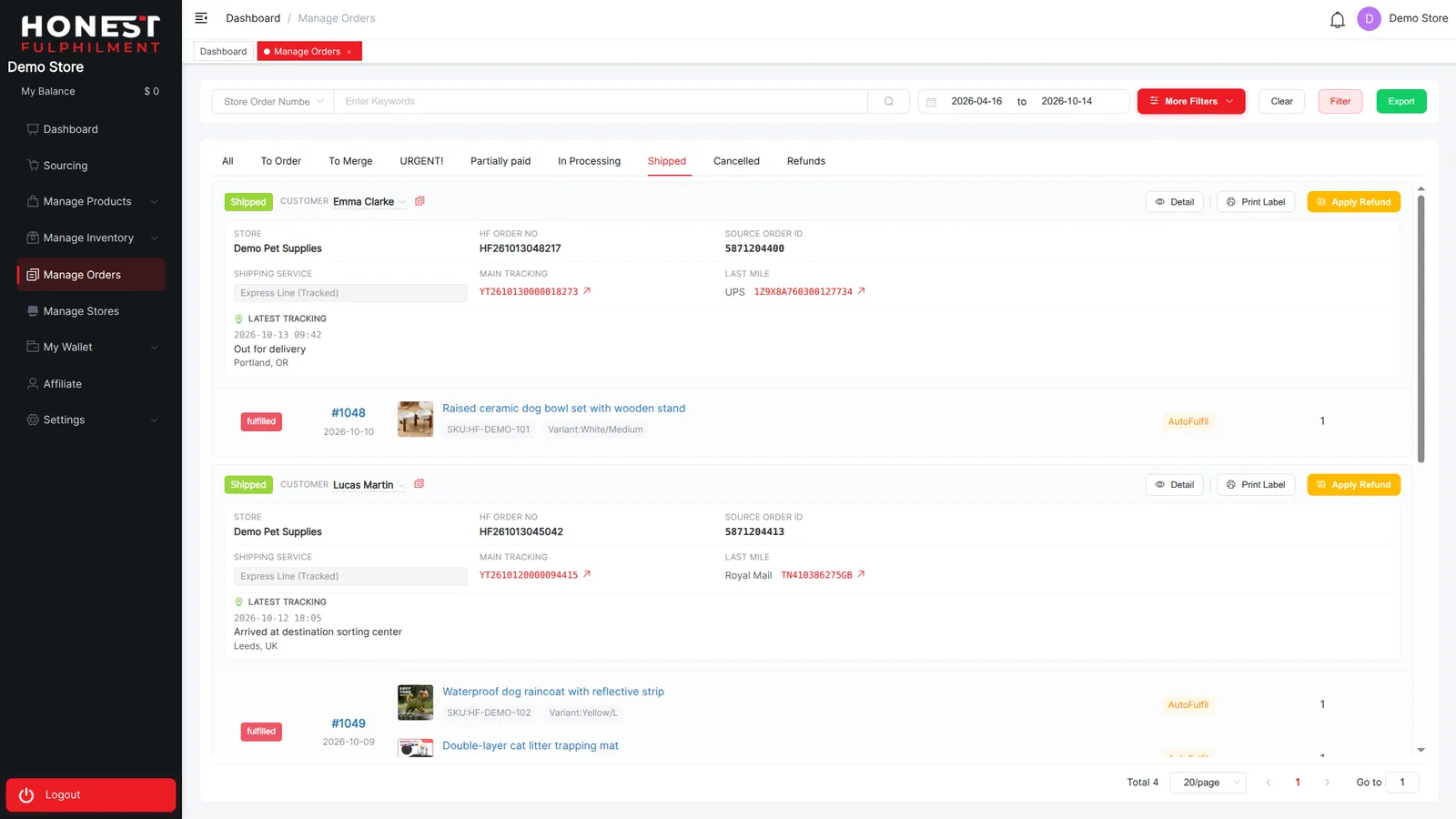
Manage Orders in the app (demo store): each shipped Shopify order shows the shipping line, the main tracking number, the last-mile carrier and the latest delivery event. With last-mile tracking on, customers see the local carrier instead of China transit legs.
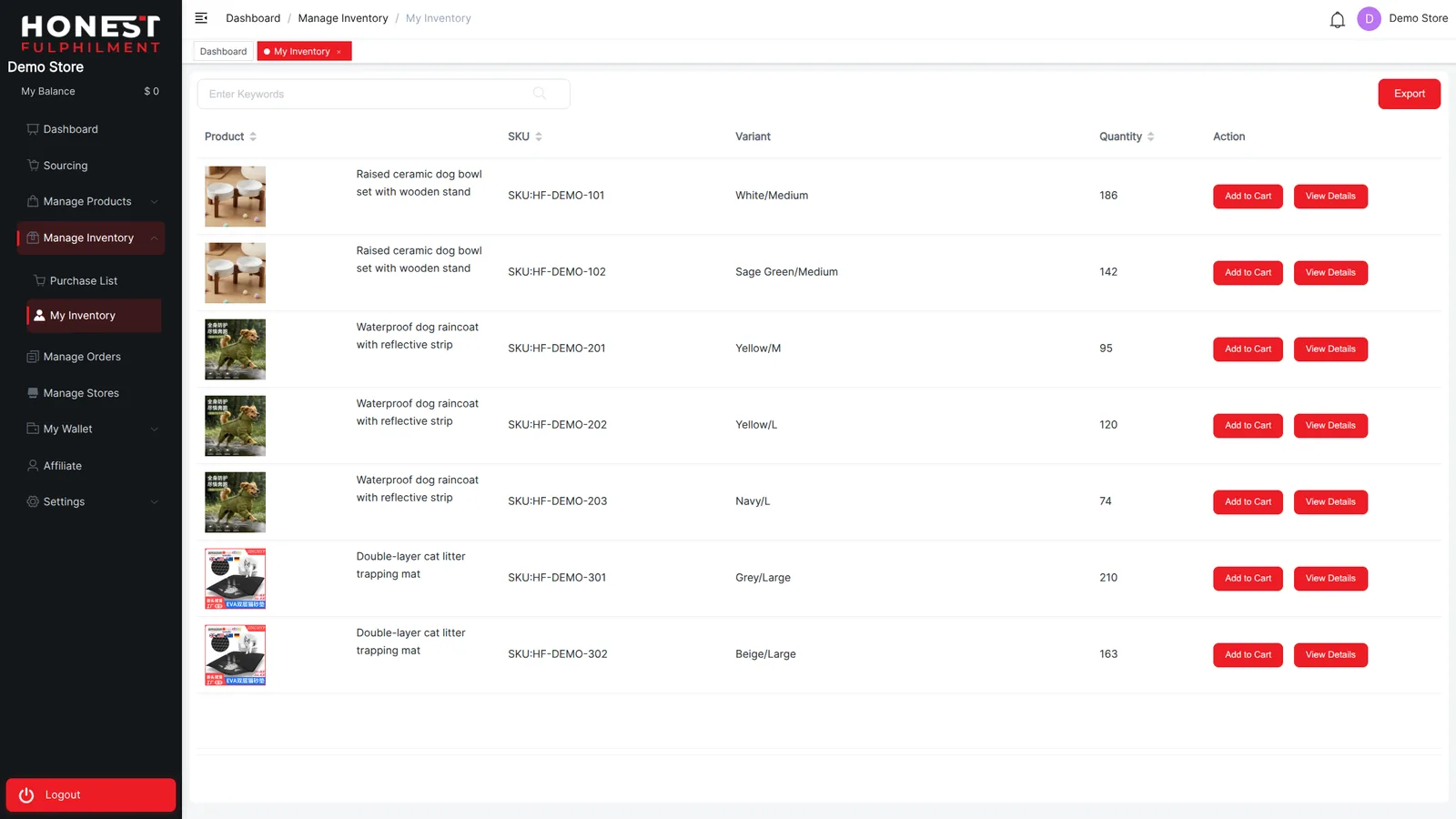
My Inventory (demo store): stock held in our warehouse by SKU and variant. With inventory sync on, these quantities update your Shopify stock levels.
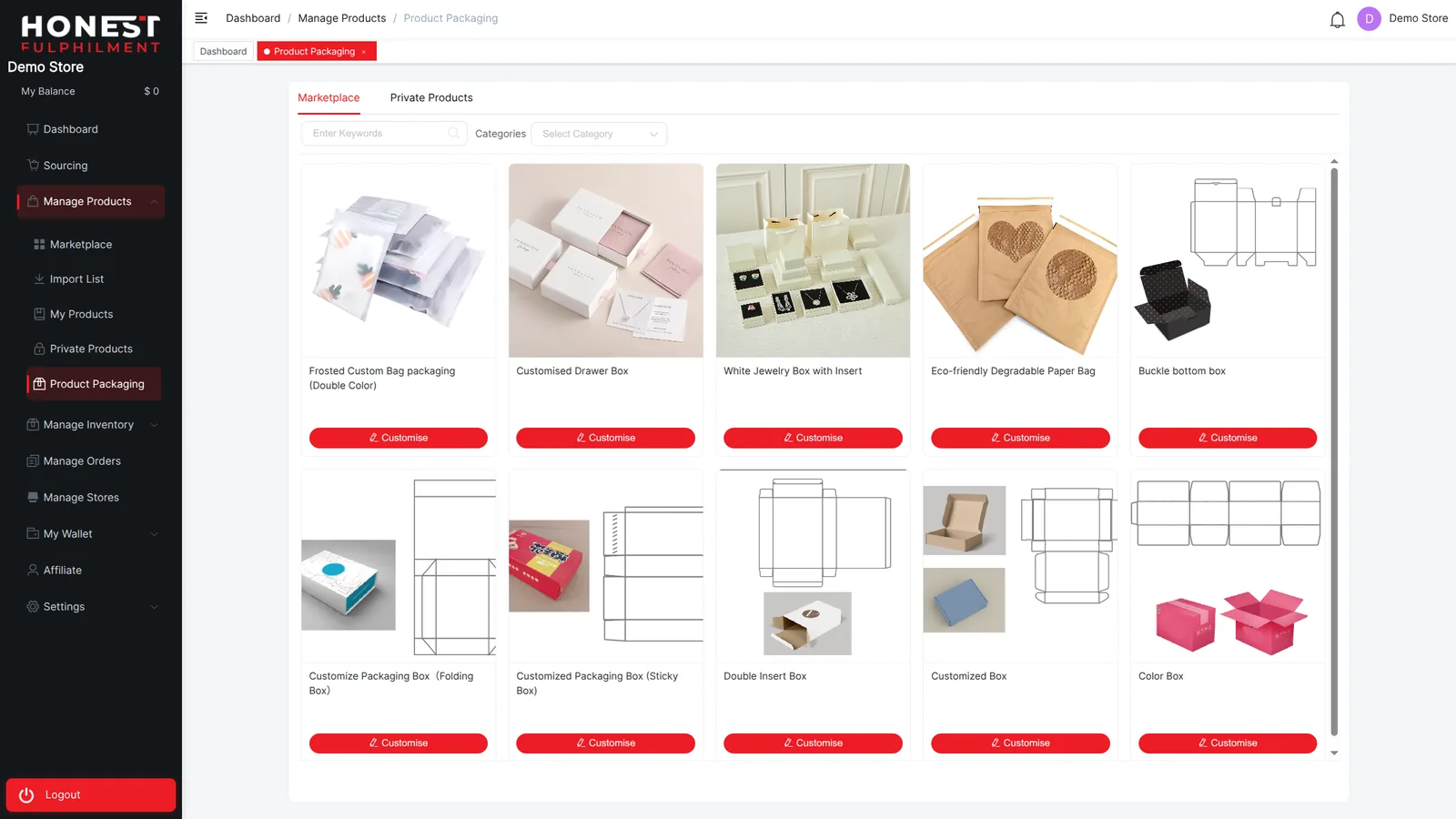
Product Packaging: pick a bag, mailer or box, customise it, and attach it to any SKU so every order ships in your branding.
There is no subscription and no contract; you pay for products, shipping and fulfillment only. WooCommerce stores can connect too, see WooCommerce fulfillment.
FAQ
How does third-party fulfillment work on Shopify?
You install the 3PL's Shopify app. It adds the 3PL as a fulfillment service (its own location) in your store. New orders for products assigned to that location are sent to the 3PL as fulfillment requests, its warehouse picks, packs and ships them, and the tracking number is pushed back so Shopify marks the order fulfilled and emails your customer.
Can I use a 3rd party to fulfill Shopify orders?
Yes. Shopify supports third-party fulfillment services alongside your own locations. You can send every product to one 3PL, or only selected products, and keep fulfilling the rest yourself.
What is a Shopify 3PL?
A Shopify 3PL is a third-party logistics company with a Shopify integration. It stores or sources your inventory, picks, packs and ships your orders, and syncs stock levels and tracking with your store.
How much does Shopify third-party fulfillment cost?
Most 3PLs charge some mix of receiving, storage, pick and pack per order or item, packaging and shipping, and some add monthly minimums or setup fees. Ask for every fee in writing and compare the total cost per order, not just the pick and pack rate.
When should a Shopify store switch to a 3PL?
Common signals are packing taking hours every day, running out of space at home or in your stockroom, shipping mistakes, or needing cheaper or faster shipping to other countries. There is no fixed order threshold; switch when packing starts limiting growth.